
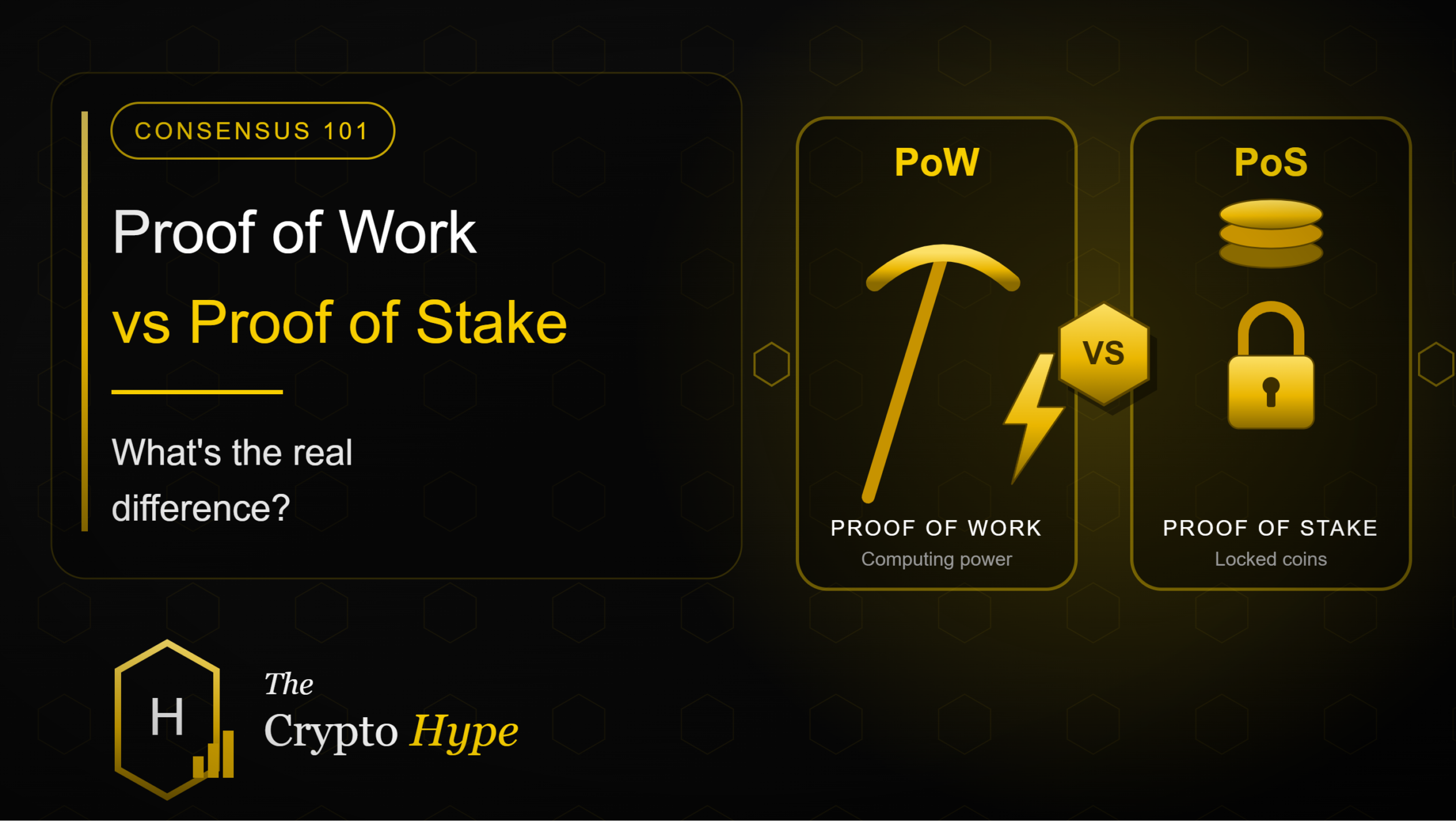
Proof of Work (PoW) and Proof of Stake (PoS) are among the best-known consensus algorithms for blockchains. Both are meant to facilitate agreement about the transactions that are legitimate and blocks that need to be appended to the blockchain in question.
The key distinction is the method of selecting participants that validate transactions and ensure network security. While PoW uses computing work, PoS uses staked cryptocurrencies.
However, the distinctions are not limited to mining and staking only. Energy consumption, hardware requirements, incentives, approaches to security, and methods of joining are also distinct.
What is a Blockchain Consensus Mechanism?
There is no central authority in the blockchain to determine the acceptance of any transaction. However, there needs to be some sort of mechanism by which all the nodes in the network agree upon the state of the blockchain.
The consensus mechanism provides the guidelines to achieve such a mechanism. In the absence of consensus, various participants can maintain their version of the blockchain.
What is Proof of Work?
Proof of Work involves having participants referred to as miners employ computational resources to solve cryptographic puzzles.
When transactions are bundled into a block, miners engage in competition to come up with a valid solution to the computational puzzle. Whichever miner comes up with the necessary proof will have an opportunity to submit the next block and get compensated for it.
Bitcoin is the most popular blockchain utilizing Proof of Work.
It becomes costly for one to tamper with the blockchain because they must have enough computing resources to compete against other miners.
How Does Proof of Work Secure a Blockchain?
PoW’s security is partly based on the price of computation.
In case a person wanted to edit the blockchain in some part, he would have to repeat the computation in the affected blocks and continue competing against the rest of the network.
This is how an economic deterrent for any possible attack is created.
As a result, miners have an interest in adhering to the network protocol since the acquisition and maintenance of mining gear is costly, whereas mining is profitable.
What Is Proof of Stake?
Proof of Stake is an alternative system.
Rather than relying on computation-based competition, validators stake cryptocurrency in the form of collateral. The protocol of the blockchain network chooses the validators based on consensus rules.
There can be varying validator selection and incentive structures in proof-of-stake networks, and hence, there may not be a single system of proof of stake.
Ethereum is an example of a proof-of-stake blockchain.
A penalty may be incurred by validators who violate the protocol.
PoW vs PoS: The Main Differences
1. Mining vs Staking
- The first clear distinction is the way the participants participate in ensuring the security of the network.
- PoW requires computation power. The miners use special hardware and compete to create new blocks.
- PoS requires stake. The validators lock their cryptocurrency and take part in accordance with the network rules of consensus.
- It implies that the hardware requirements may differ greatly between them.
2. Energy Consumption
- PoW mining needs to use quite a bit of electricity since the miners always have to do their computation tasks.
- PoS is not based on such competition where continuous computational work is needed.
- This means that PoS requires much less electricity for consensus formation compared to PoW mining.
- But at the same time, it all depends on the entire infrastructure around the blockchain in question, which means it cannot be simply stated that PoS requires zero energy usage.
3. Hardware Requirements
- PoW mining can involve specialized hardware, particularly on established networks where mining difficulty is high.
- PoS generally requires validator hardware capable of running blockchain software reliably, but it does not require miners to compete by performing increasingly large amounts of hashing work.
- This can change the economic structure of participation.
4. Security Model
- Both mechanisms are designed to make attacks economically difficult, but they do so differently.
- In PoW, an attacker generally needs significant computational resources and access to substantial mining capacity.
- In PoS, an attacker may need to control a significant amount of the network’s staked assets or otherwise manipulate the validator system.
- PoS also introduces penalties such as slashing in many implementations, meaning dishonest validator behavior can result in financial losses.
5. Rewards
- PoW miners can earn rewards through block subsidies and transaction fees, depending on the blockchain’s design.
- PoS validators can receive rewards for proposing or validating blocks and performing other protocol duties.
- Both systems therefore create economic incentives for participants to help maintain the network.
- However, the economics are different. PoW participants generally spend money on hardware and electricity, while PoS participants commit capital through staking.
Which One Is More Decentralized?
- It depends on many parameters.
- Decentralization of PoW depends on factors such as mining rig availability, electricity costs, mining pools, and location clustering.
- Decentralization of PoS depends on factors like coin distribution, validator clustering, staking service providers, staking arrangements, and validator selection process.
- Thus, stating simply that one mechanism is automatically more decentralized than the other is oversimplifying things.
Can Proof of Work and Proof of Stake Both Be Secure?
Yes. Security is determined by far more than just the consensus algorithm.
It is determined by the blockchain’s architecture, economics, distribution of validators/miners, network activity, code quality, governance, and assumptions about attacks.
Proof-of-Work is very dependent upon the cost of obtaining and running sufficient computational capacity. Proof-of-Stake is very dependent upon the economics at stake.
Neither consensus algorithm can eliminate all threats.
Which one should you ultimately choose?
The main difference between Proof of Work and Proof of Stake is that both need something from their participants in order to guarantee the security of the network.
The first protocol needs from miners computational power and electricity for mining. The second protocol demands from validators cryptocurrency as economic collateral.
Proof of Work is a well-established mechanism of blockchain protection that relies on resource spending. The Proof of Stake works differently and uses financial penalties inside blockchain for its security.
This knowledge will clarify the differences between these two mechanisms regarding energy consumption, equipment, participation, rewards, and security.
FAQs
Is Bitcoin Proof of Work or Proof of Stake?
The Bitcoin network runs on Proof of Work. The miners are engaged in competition with computing power for the production of blocks and their security.
Is Ethereum Proof of Work or Proof of Stake?
The Ethereum network runs on Proof of Stake. The nodes in the network are called validators and stake ETH and participate in proposing and validating the blocks.
Which consumes more energy, Proof of Work or Proof of Stake?
Proof of Work requires much more electricity as the miners engage in computational efforts all the time. Proof of Stake does not engage in mining competitions and hence requires much less energy.
Can a blockchain move from Proof of Work to Proof of Stake?
It is possible to change the consensus method in a blockchain, but the process is technically very complicated. The Ethereum blockchain has successfully moved from Proof of Work to Proof of Stake in 2022.