
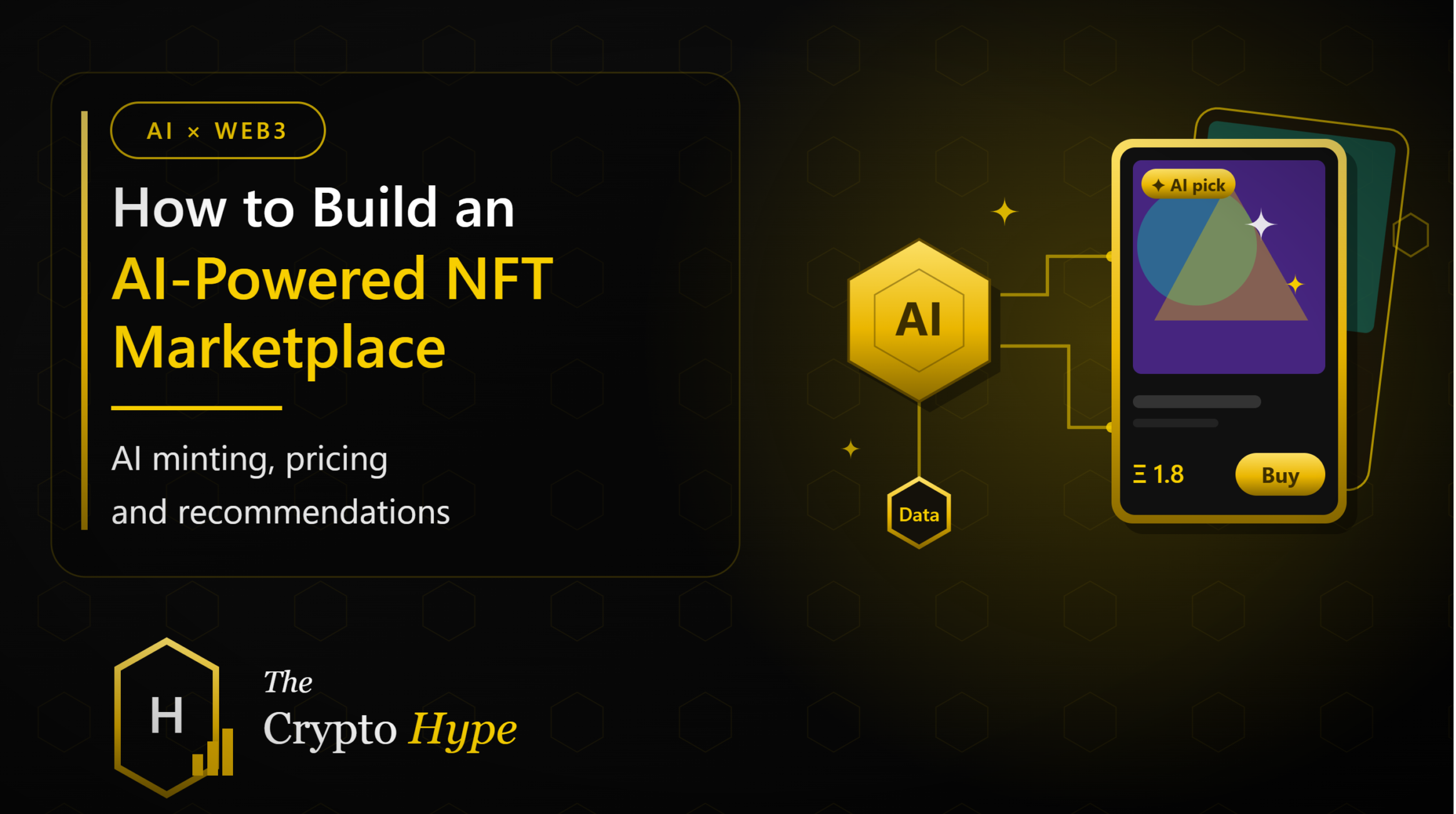
The NFT marketplace enables users to mint, trade, purchase, and sell digital assets through the use of blockchain technology. Artificial Intelligence could be integrated into the NFT marketplace to enhance functionality in areas such as search, recommendation, anti-fraud analysis, price analysis, and content management.
An AI-driven NFT Marketplace is a combination of blockchain technology and AI technologies. Blockchain technology will provide an infrastructure for the transfer of assets while AI can assist the user in discovering, analyzing the collection of assets, and detecting any anomalies.
The construction of an NFT marketplace requires various components including:
What Is an AI-Powered NFT Marketplace?
AI-powered NFT Marketplace is an online space where users can engage in various NFT-related activities with assistance from AI at every step.
The following functions can be provided by a marketplace:
- Linking of the user’s crypto wallet
- Browsing of NFT collections
- Creation of NFTs
- Buying and selling of NFTs
- Placing offers
- Searching for particular items
- Reviewing the ownership history
- Analysis of NFTs
Some examples of AI capabilities include personalization, search by natural language, generation of content (descriptions), images’ analysis, and suspicious activity detection.
The list of functions implemented may vary depending on target users and supported types of NFTs.
Step 1: Define the Marketplace
Start by determining the kind of NFT marketplace that you want to create.
A general marketplace would have more than one type, while a specialized marketplace may deal with digital arts, gaming assets, collectibles, music, or some other category.
You need to determine:
- The types of NFTs you support
- Blockchain platform you will use
- Whether users can mint NFTs
- Payment assets you accept
- Whether there are auctions in your platform
- Whether there are any fees for transactions in your marketplace
- What AI capabilities your marketplace needs
Defining your requirements beforehand helps save development efforts.
Step 2: Choose a Blockchain
The blockchain provides the infrastructure for NFT ownership and transactions.
Ethereum is widely used for NFTs, but other networks can offer different transaction costs, speeds, and ecosystems.
When choosing a blockchain, consider:
- Transaction fees
- Network speed
- NFT standards
- Wallet support
- Developer tools
- Marketplace ecosystem
- Smart contract security
For development, you can initially deploy contracts to a testnet before moving to a production network.
Step 3: Build the NFT Smart Contracts
Smart contracts define how NFTs are created, transferred, bought, and sold.
For Ethereum-compatible networks, NFT contracts commonly use standards such as ERC-721 or ERC-1155.
A marketplace may require separate contracts for NFT creation and marketplace transactions.
The contracts can define rules for:
- Minting
- Ownership transfers
- Listings
- Purchases
- Offers
- Auctions
- Marketplace fees
- Royalties
Because these contracts can handle real assets and funds, they should be carefully tested and independently audited before significant use.
Step 4: Choose NFT Storage
The blockchain does not necessarily store the complete image, video, or audio file associated with an NFT.
Instead, the NFT can contain metadata that points to the digital asset.
You therefore need a suitable storage system for images, videos, audio, NFT metadata, collection information, etc.
Decentralized storage solutions can help make NFT assets less dependent on a single centralized server.
The marketplace should also consider backup and content availability because losing metadata or media files can negatively affect the NFT experience.
Step 5: Build the Marketplace Interface
The frontend is where users interact with the marketplace.
A typical interface can include:
- Home page
- NFT discovery page
- Collection pages
- NFT detail pages
- Creator profiles
- Wallet connection
- Buying and selling interface
- User dashboard
The frontend communicates with blockchain contracts through Web3 libraries and wallet providers.
When a user purchases an NFT, for example, the interface can request wallet approval before sending the transaction to the blockchain.
Step 6: Add AI-Powered Search
- One of the most valuable applications of AI technology is natural-language NFT search.
- Instead of having users only look up NFTs by collection names or categories, AI can understand natural queries from users.
- For example, one could look up:”Search for colorful artwork with future city themes.”
- The system will be able to understand the query and provide results according to the parameters.
- NFT search powered by AI could help in making a marketplace more user-friendly.
Step 7: Create Personalized Recommendations
Recommendations can be made regarding NFTs based on user behavior.
The recommendation engine could look at signals such as:
- NFTs viewed in the past
- Collections followed
- Search behavior
- Purchase history
- Categories of interest
It can then determine which collections/NFTs may be relevant to the user.
But recommendations must be clear on what data is being used, especially if the platform is tracking user behavior.
Step 8: Add AI-Based NFT Descriptions
- There might be cases when the creators do not have enough time and skills to write extensive metadata.
- AI can help in creating drafts of the metadata according to the information provided by the creator.
- For instance, the creator can provide the name of the art piece, its theme, and main attributes. AI will create the draft that will be reviewed by the creator before publishing.
- AI-generated texts cannot be posted without any user reviews since the question of accuracy and ownership is quite serious.
Step 9: Add Image and Content Analysis
Computer vision models can analyze NFT images and identify visual characteristics.
This can help with:
- Automatic categorization
- Image tagging
- Duplicate detection
- Visual search
- Content moderation
For example, the system could automatically identify broad characteristics such as colors, objects, or artistic styles and use those attributes to improve search and discovery.
Step 10: Build Fraud Detection
AI can also assist with identifying potentially suspicious activity.
A marketplace could monitor unusual patterns such as:
- Rapid transfers between wallets
- Unusual trading activity
- Suspicious collection behavior
- Repeated metadata patterns
- Sudden changes in transaction activity
AI can flag these patterns for additional review.
However, an AI-generated risk score should not automatically be treated as proof that an account or NFT is fraudulent. Human review and blockchain-based evidence can provide additional context.
The best practice for making AI useful for your business
Blockchain provides ownership records and transaction infrastructure. Smart contracts automate marketplace rules, while AI can improve discovery, recommendations, content management, moderation, and analytics.
A practical development process starts with a focused marketplace and a small number of AI features. Once the core buying, selling, and ownership functions are secure, more advanced AI capabilities can be introduced.
The most important goal is to make AI useful without making it the source of truth. Ownership and transactions should remain verifiable on-chain, while AI should primarily assist users with discovery, analysis, and automation.
FAQs
What features of AI can help the NFT marketplace work better?
With the help of AI, an NFT marketplace can have such functionalities as recommendations, natural language search, automated description, image analysis, anti-fraud system, and pricing analytics. With those, the users would find it easier to browse for NFTs.
Which blockchain is suitable for an AI-based NFT marketplace?
As there is no blockchain best for every project, the choice of a particular network depends on transaction costs, speed, NFT standards, wallets used, and other specifics of a project.
How much would it cost to develop an AI marketplace for NFTs?
The price would depend on the specificities of the marketplace (features, chosen blockchain, complexity of smart contract, AI capabilities, design, etc.). So the price for the basic marketplace would be lower than that of the one with AI search, recommendations, analytics, auctions, and moderation.
Is it secure to use an AI marketplace for NFTs?
It depends on the development process and further maintenance of the platform. Firstly, you should test and audit your smart contracts. Moreover, it is necessary to monitor the performance of the AI algorithms for any incorrect suggestions, false classifications, etc.