
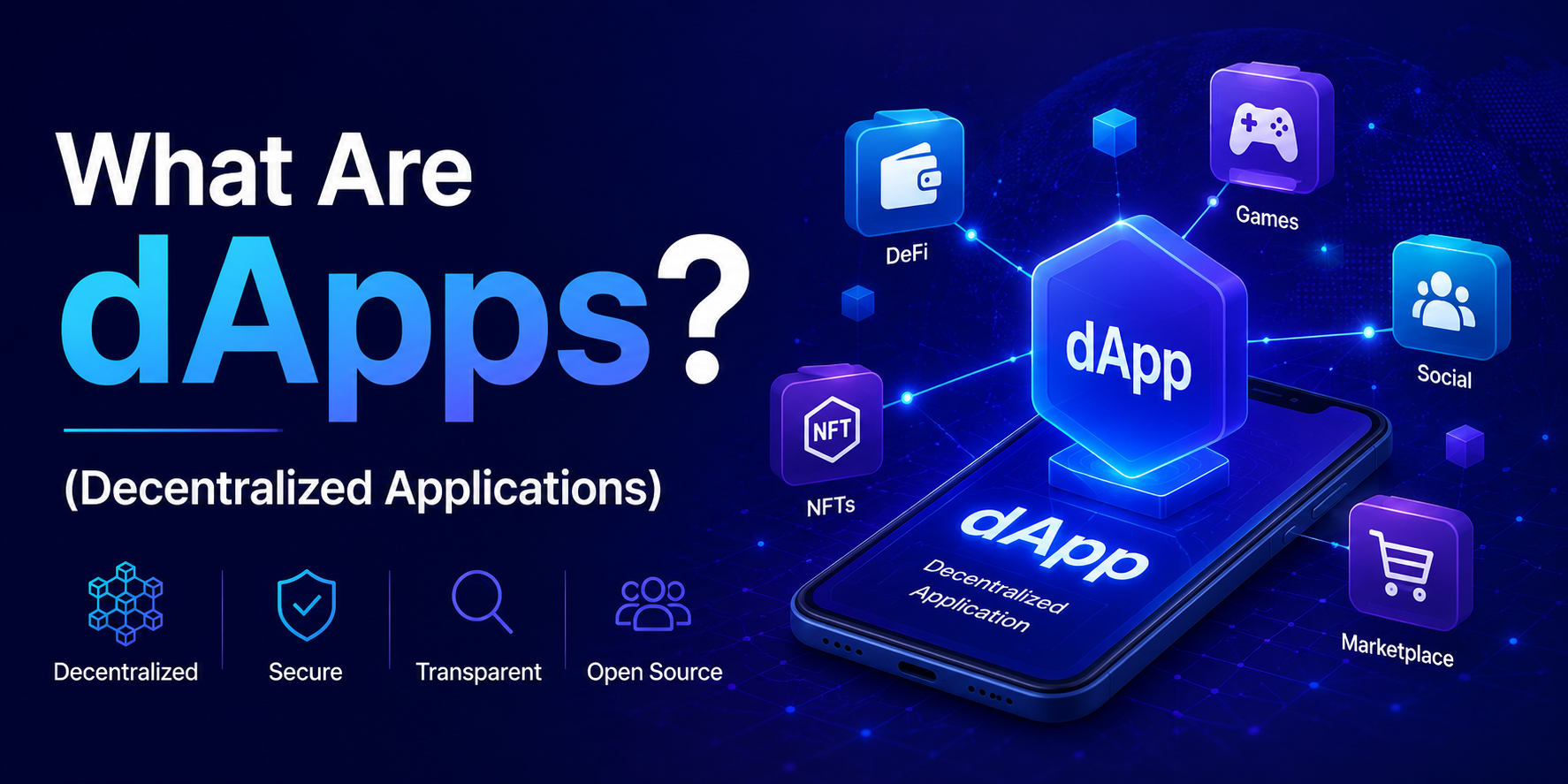
A decentralized application (dApp) is a software application that runs on a blockchain network instead of being hosted on centralized servers controlled by a single company or authority.
Traditional apps like social media platforms, banking apps, or e-commerce websites operate through centralized systems where a company manages the servers, stores user data, and controls the platform. In contrast, dApps use blockchain technology and smart contracts to perform many of these functions automatically and transparently.
Popular blockchain networks that support dApps include Ethereum, Solana, BNB Chain, Avalanche, and Polygon.
How Do dApps Work?
At the core of every dApp are smart contracts.
Smart contracts are self-executing pieces of code stored on a blockchain. These contracts automatically carry out actions when specific conditions are met. For example, in a decentralized lending platform, smart contracts can automatically approve loans, manage collateral, and process repayments without requiring a bank or intermediary.
A typical dApp consists of:
- A user interface (frontend) similar to a regular website or mobile app
- Smart contracts running on a blockchain
- A cryptocurrency or token that powers transactions within the application
Users generally connect their crypto wallets, such as MetaMask, to interact with the dApp.
Key Features of dApps
1. Decentralization: Unlike traditional applications, dApps are not controlled by a single organization. Their data and operations are distributed across multiple nodes on a blockchain network.
2. Transparency: All transactions and smart contract activities are recorded on the blockchain and can often be verified publicly.
3. Security: Because blockchain data is distributed and protected through cryptography, dApps can be more resistant to hacking and data manipulation.
4. User Ownership: Users maintain control of their funds and digital assets through their personal wallets rather than trusting a centralized company to hold them.
5. Open Source: Many dApps make their code publicly available, allowing developers to review, improve, and build upon existing projects.
Examples of Popular dApps
Decentralized Finance (DeFi): Platforms like decentralized exchanges and lending protocols allow users to trade, borrow, and lend cryptocurrencies without traditional financial institutions.
NFT Marketplaces: NFT dApps enable users to create, buy, sell, and trade digital collectibles directly on blockchain networks.
Blockchain Gaming: Play-to-earn games reward players with cryptocurrencies or NFTs while giving them ownership of in-game assets.
Social Media Platforms: Decentralized social networks aim to give users greater control over their content and personal information.
What are the Benefits of dApps?
The growing popularity of dApps can be attributed to several advantages:
- Reduced reliance on intermediaries
- Greater transparency and trust
- Enhanced security through blockchain technology
- Improved accessibility across borders
- User control over assets and data
- Lower risk of censorship or platform shutdowns
These benefits make dApps attractive for industries ranging from finance and gaming to healthcare and digital identity management.
Challenges of dApps
Despite their potential, dApps still face several limitations:
- Scalability issues on some blockchain networks
- Complex user experience for beginners
- Transaction fees that can become expensive during network congestion
- Regulatory uncertainty in some regions
- Smart contract vulnerabilities if the code contains bugs
Developers are actively working on solutions to address these challenges and improve adoption.
As blockchain technology matures, dApps are expected to become faster, more user-friendly, and more widely adopted. Innovations such as Layer 2 scaling solutions, improved wallet technology, and enhanced blockchain infrastructure are helping create a better user experience.
From decentralized finance and gaming to social media and digital identity, dApps have the potential to reshape how online services operate by giving users more control and reducing dependence on centralized platforms.
Decentralized applications represent one of the most exciting innovations in the blockchain space. By combining blockchain technology with smart contracts, dApps offer secure, transparent, and user-centric alternatives to traditional applications. While challenges remain, their growing adoption suggests they will play a significant role in the future of the internet and digital economies.