
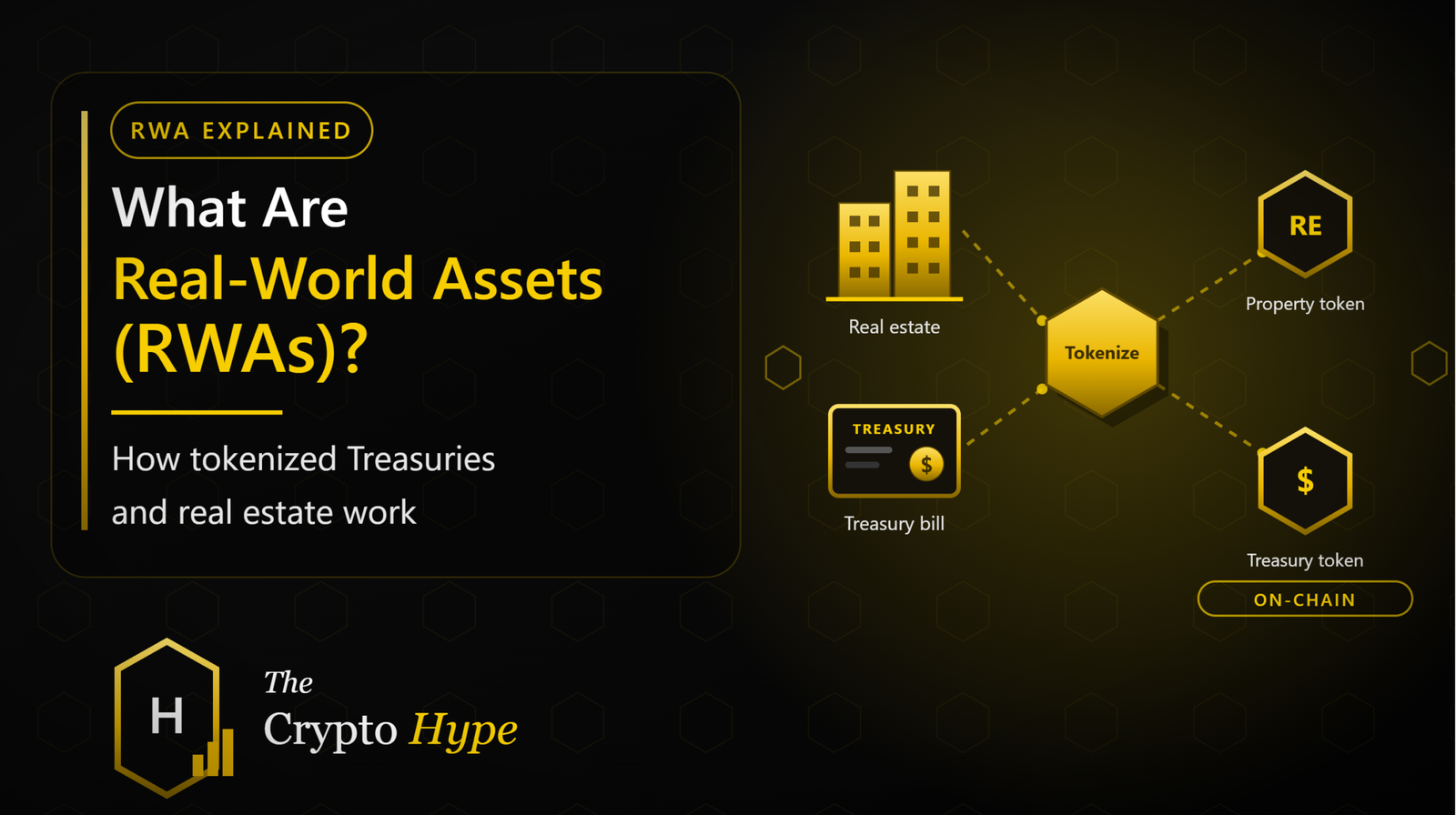
Real World Assets (RWAs) are conventional financial or physical assets in the form of digital tokens created on a blockchain. RWAs may consist of government bonds, real estate, precious metals, private credit, and investment funds.
In contrast to cryptocurrencies like Bitcoin and Ethereum, which emerge inside the blockchain network itself, the value of RWAs comes from assets external to the blockchain.
This is achieved through tokenization, whereby an issuer creates digital tokens that stand for certain rights, financial interests, or claims to the underlying asset.
For instance, the token may refer to shares of the fund investing in government bonds or ownership interest in a business owning commercial real estate.
The concept implies bridging traditional financial markets and blockchain.
How Does RWA Tokenization Work?
Tokenization entails more than creating a digital token; it necessitates having a mechanism that will connect the blockchain-based token representation with the asset itself.
This usually includes the following five steps:
- Selection of the asset: The entity that wants to issue a token selects an asset such as Treasury bills, property or a portfolio of loans.
- Legal structuring: The selected asset is legally structured using vehicles like funds, trusts or SPVs.
- Safekeeping and certification: The underlying financial or physical asset is safekept by a custodian, while the documentation or valuation confirms its existence.
- Issuance of tokens: A smart contract issues digital tokens that represent ownership rights that were created through the legal structuring.
- Distribution and management: Investors who are qualified for the issuance of tokens buy or get issued tokens, which may be transferred according to the product terms.
A smart contract can automatically perform tasks such as the issuance, transfer, eligibility of the investor and distributions of income.
Nonetheless, the documents in the legal structuring define what rights the token holders will have. Owning an RWA token does not necessarily mean ownership of the physical asset.
What Are Tokenized US Treasuries?
Treasuries are instruments that represent debt obligations issued by the US government. The US Treasuries consist of Treasury bills, Treasury notes, and Treasury bonds.
The Tokenized Treasuries provide investors with exposure to the traditional financial instruments through blockchain technology.
Rather than buying a share of traditional financial instruments via traditional financial systems, the eligible investors can buy blockchain tokens reflecting an ownership interest in a fund or structure with Treasuries.
How Do Tokenized Treasuries Work?
Imagine a fund which has Treasury bills of US. The fund holds Treasury securities via existing finance and custody infrastructure. The token issuer issues blockchain tokens which represent interests of eligible investors in the fund. Eligible investors buy tokens via an approved platform.
The returns from investments are reflected either in the value of the product or are distributed via the product.
Eligible investors can cash out the tokens via the issuer based on certain eligibility criteria and conditions for redemption.
Some products pay income periodically, while some other products reflect returns in form of their NAV.
For example, there are BlackRock’s BUIDL and Franklin Templeton’s BENJI-linked fund shares. Such products illustrate how blockchain-based issuance and transfer can be used by traditional investment vehicles.
Tokenized Treasuries may provide blockchain-based settlement mechanism and financial exposure via traditional instruments. But tokenized Treasuries cannot be automatically issued to any crypto wallet.
How Does Tokenized Real Estate Work?
Another application area for RWA tokenization is real estate. Traditionally, real estate investing requires a great deal of money, documents, and procedures for transferring property from one owner to another.
Tokenization could be used to tokenize the stake in the property in the form of tokens.
Benefits of Real-World Asset Tokenization
RWA tokenization offers several potential advantages:
- Fractional ownership: Investors can access smaller portions of certain high-value assets.
- Improved settlement: Blockchain infrastructure can simplify how eligible digital asset transfers are recorded and settled.
- Greater accessibility: Tokenization may open certain traditional investment opportunities to a wider investor base, subject to regulations.
- Transparency: On-chain records make token issuance and transfers easier to verify.
- Programmability: Smart contracts can automate distributions, compliance checks, and other investment processes.
These benefits depend on the quality of the underlying legal, financial, and technical infrastructure.
The Future of RWAs in DeFi
The real-world tokenization of assets is generating bridges between conventional finance and decentralized finance. Tokenized treasuries, property rights, and private credit instruments could help expose various kinds of financial risk to blockchain-based platforms.
With evolving infrastructure, such tokens could find their way into digital wallets, lending agreements, and other kinds of financial applications.
However, wider adoption would need clear regulation, custody solutions, protection of investor rights, and solid blockchain infrastructure.
FAQs
What is the meaning of RWA regarding cryptocurrencies?
The abbreviation RWA means Real-World Asset. This term describes traditional financial or tangible assets represented via a blockchain token like government bonds, real estate, gold, or private credit.
Do tokenized real-world assets belong to cryptocurrencies?
No. Cryptocurrencies like Bitcoin are the examples of native digital assets while RWAs represent certain claims and interests concerning assets existing outside the blockchain environment.
Can investors receive a return from tokenized Treasuries?
Yes. In accordance with the specific product, it is possible to get a return produced by Treasury securities through distributions or appreciation of the fund.
Is tokenized real estate a good investment?
Not always. Tokenized real estate is subject to the risk of the property market, liquidity, legal issues, custodial and smart-contract risks. Investors should consider the nature of tokens (direct ownership, company’s shares, or income claims).