
Ethereum is among the most common blockchains used to build decentralized applications, smart contracts, decentralized finance (DeFi), non-fungible tokens (NFTs), and other Web3 services. Nevertheless, congestion issues may occur when more and more users and applications use Ethereum and try to write their blocks.
Layer 2 (L2) technologies help solve such problems by offering a faster way to perform transactions with Ethereum still providing its security and settlement.
Among various L2 technologies, rollups have emerged as one of the most significant ones.
What is Layer 2?
- Layer 2 is an additional blockchain or network that is created based on the existing blockchain called Layer 1.
- In this scenario, Ethereum is Layer 1. Some transaction activity is conducted off the main chain of Ethereum and then using the power of Ethereum for security and verification or settlement of those transactions.
- This means that there is no need to ask Ethereum to perform each individual transaction, but rather an L2 will conduct multiple transactions and only then send the results to Ethereum.
- Ethereum becomes cheaper and more scalable when more transactions happen, all without replacing it.
Why does Ethereum need Layer 2?
- Ethereum has limited space available for each block. There is a maximum amount of information and transactions that each block can have.
- With more demand, people will pay more fees known as gas fees in order to access the available space. As a result, small transactions may become costly and make the use of Ethereum less practical.
- The use of Layer 2 networks helps to decrease the load on the Ethereum network by performing most of the transactions off-chain.
How do Rollups work?
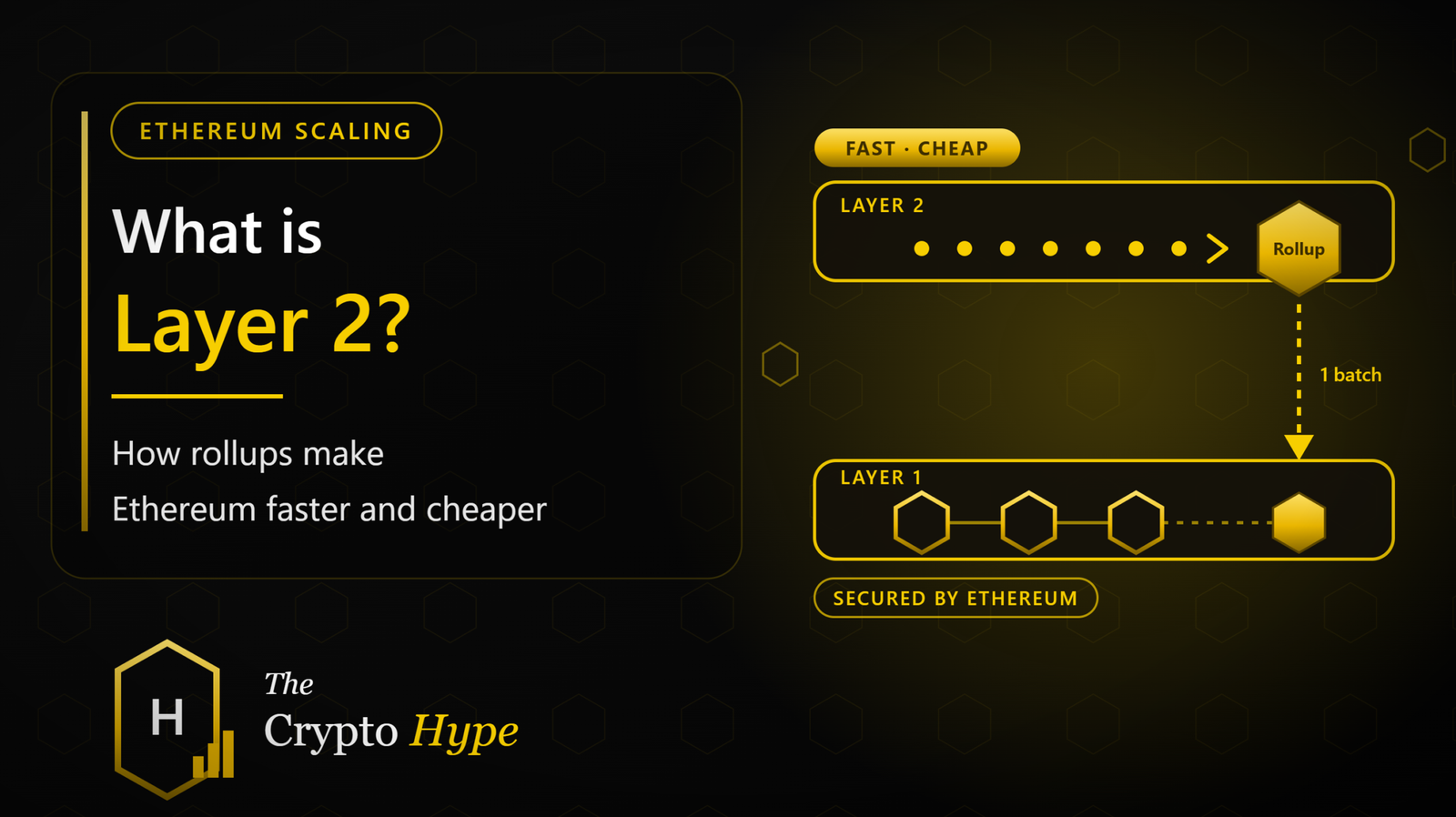
Rollups are Layer 2 scalability mechanisms that operate outside Ethereum’s main execution layer, performing transactions on Layer 2 and then bundling these transactions into batches referred to as “rolling up”.
Rather than uploading each individual transaction to Ethereum individually, the rollup bundles multiple transactions into one and then submits an abridged version or proofs to Ethereum.
This makes it possible to save on blockchain space per transaction.
One of the simplified mechanisms looks like the following:
- Users upload transactions to Layer 2.
- Layer 2 executes many transactions.
- These transactions are combined into a batch.
- Transaction proofs or data are uploaded to Ethereum.
- Settlement and security are provided by Ethereum.
Since many transactions can split the cost of interacting with Ethereum, the cost per individual transaction can be significantly reduced.
Why are Rollups faster?
- There are many restrictions on the number of transactions that can be processed in the Ethereum network. Through the use of rollups, transaction capacity is enhanced through the off-chain execution of transactions.
- Users would be able to enjoy quicker transactions without the network being congested with transactions.
- It should be noted that the word “quicker” does not necessarily equate to the instant confirmation of transactions in the Ethereum blockchain.
Popular Layer 2 Networks
- The Ethereum ecosystem includes several major Layer 2 networks built using different technologies and approaches. Examples include Arbitrum, Optimism, Base, zkSync, Starknet, etc.
- These networks differ in their architecture, compatibility, transaction costs, applications, and security mechanisms.
- Users should always understand which network they are using before transferring funds because assets and applications may behave differently across networks.
Are Layer 2 Networks part of Ethereum?
Layer 2 networks are separate execution environments, but they are closely connected to Ethereum.
They generally use Ethereum as a settlement or security layer, depending on their design. This means users can benefit from Ethereum’s established ecosystem while transactions are processed more efficiently elsewhere.
This relationship is one of the key ideas behind Ethereum’s broader scaling strategy.
Layer 2 vs. Layer 1
- It would be simplest to consider Layer 1 to be the settlement layer while Layer 2 can be considered an added execution layer to Layer 1.
- Layer 1 offers the basic blockchain and its security.
- Layer 2 takes care of transaction execution away from the main chain but occasionally informs Layer 1 about such transactions.
- Thus, both layers combined can scale Ethereum by taking care of transactions that do not need to be executed on the main chain.
Things to consider
- Layer 2 networks are important elements of the approach used by Ethereum in addressing the issue of scalability. Instead of having Ethereum deal with each transaction individually, the layer 2 networks handle transactions much more efficiently and provide the relevant information to Ethereum.
- Rollups are better in that they combine several transactions into one in order to reduce cost and speed up transactions.
- As the platforms Ethereum and Web3 grow bigger, the layer 2 networks can prove useful in increasing their efficiency.
FAQs
Is Layer 2 equivalent to Ethereum?
Not at all. Ethereum is considered the base Layer 1, and Layer 2s are auxiliary systems that operate separately but utilize the Ethereum network either for validation or settlement.
What is a rollup in cryptocurrencies?
Rollups are the Layer 2 scaling solution used to group many transactions, process them, and submit data or cryptographic proofs to Ethereum.
What is the difference between Optimistic and ZK-rollups?
Optimistic rollups tend to consider transactions as valid until proven otherwise, and ZK-rollups rely on cryptographic validity proofs to show that transactions were performed correctly.
Are Layer 2 transactions cheaper than those of Ethereum?
The idea is that Layer 2 transactions are meant to be cheaper because transactions are performed in L2, and the cost is shared between transactions. But it varies based on particular conditions.